BILL GATES by ANTOINE LEGRAND

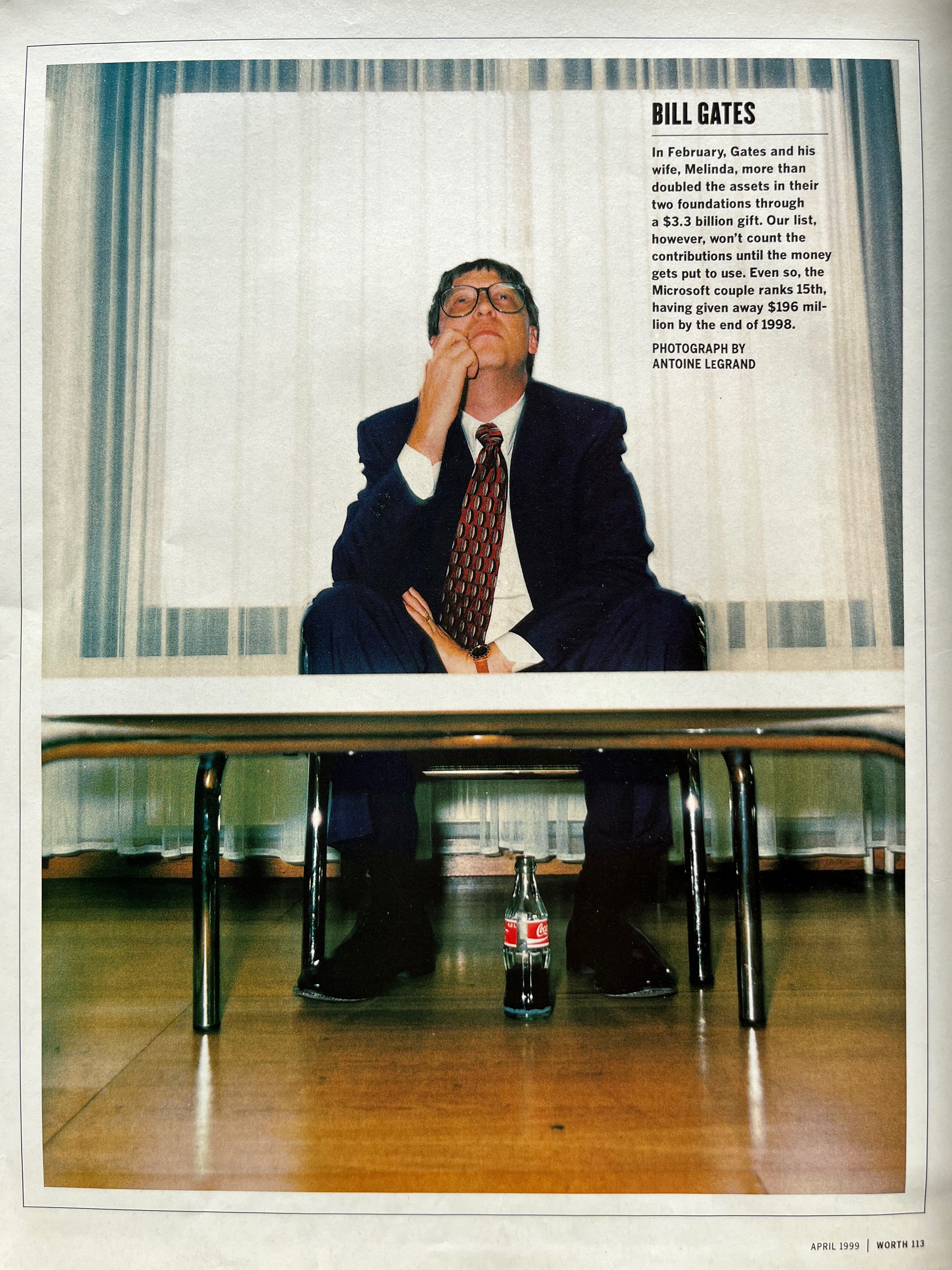
I was going through my box of newspaper and magazine clippings and found this page from the April 1999 issue of Worth magazine. The caption reads: 

BILL GATES
In February, Gates and his wife, Melinda, more than doubled the assets in their two foundations thorugh a $3.3 billion gift. Our list, however, won't count the contributions until the money gets put to use. Even so, the Microsoft couple ranks 15th, having given away $196 million by the end of 1998.

PHOTOGRAPH BY ANTOINE LEGRAND

Well, my interest in this photo is really the contour glass bottle.  Clearly it's a Coke bottle partially full (or empty) with a paper label.  It's definitely not an American bottle, likely an European one.  Was the bottle just a prop or did it belong to Mr. Gates (or Mr. Le Grand)?

According to Mr. Gates, he drank 3-4 Diet Cokes in the office back in 2014. (See GatesNotes - The Blog of Bill Gates from June 12, 2014) Maybe he switched from Coke to Diet in the new millennium.

Elon Musk had tweeted posted a photo of his bedside table on November 28, 2022 with 4 opened (or emptied) Caffeine-free Diet Coke cans.

Warren Buffet of course is a well known decades-long Cherry Coke drinker and in 2017 a special edition of Cherry Coke was produced in China in his honor.


Coca-Cola Insiders Club 2021

How did you sign up for the Coca-Cola® Insiders Club?


On December 8, 2020, I signed up for the Coca-Cola Insiders Club Membership via an email link from The Coca-Cola Company:

From: Coca-Cola Brands

Date: December 8, 2020

Subject: Available now: Coca Cola Insiders Club membership

Message:

BECOME A COCA-COLA 
INSIDER TODAY
Now’s your chance to join this exclusive club and try new, refreshing Coca-Cola beverages before they hit shelves nationwide – plus so much more! Sign up for yourself or give it as the perfect holiday gift, but don’t wait, because spots are filling up fast!

Coca-Cola in Different Scripts


Tomorrowland

A few years ago I was collecting Coca-Cola written in different language scripts in electronic form. With the help of Unicode, Google, Firefox and a refreshingly talented linguist, Sam Giloi, here is the list we compiled:

Arabic (Arabiyya) کوکا کولا
Amharic ኮካ-ኮላ
Armenian* Կոկա-Կոլա
Bengali কোকা-কোলা
Cantonese (Yale)* Hóháu-Hólohk
Cherokee* ᎪᎧ ᎪᎳ
Chinese (bopomofo) ㄎㄜˇㄎㄡˇㄎㄜˇㄌㄜˋ
Chinese (Cyrillic)* Кэкоу-Кэлэ
Chinese (Gwoyeu Romatzyh)* Keekoou-Keeleh
Chinese (IPA)* kʰɤkʰoukʰɤlɤ
Chinese (pinyin) Kěkǒu-Kělè
Chinese (simplified) 可口可乐
Epcot
Chinese (traditional) 可口可樂
Chinese (Wade-Giles) K'ok'ou-K'ole
Elmer Fudd* Coca-Cowa
English (AHD) kō'kəkō'lə
English (Bristol Dialect)* Coca-Colawl
English (IPA American)* koʊkə'koʊlə
English (IPA Australian)* kəʉkə'kəʉlə
English (IPA British)* kəʊkə'kəʊlə
English (IPA Canadian)* kokə'kolə
English (IPA Cockney)* kʌʊlə'kʌʊlə
English (IPA Derry)* kʲokʲə'kʲolə
English (IPA Estuary)* kəʏlə'kəʏlə
English (IPA Philippine)* kokɐ'kolɐ
English (IPA Runglish)* 'koukakoula
English (IPA Scottish)* kokə'kolə
English (IPA Singlish)* kokə'kolə
English (Latin) Coca-Cola
English (Swedish Chef)* Cuca-Cula
English (Yorkshire Dialect)* Coca-Coleur
Esperanto Koka-Kolao
Estonian Koka-Kola
Faux Cyrillic* CФCД CФLД
Georgian კოკა-კოლა
Greek* Κόκα-Κόλα
Gujarati કોકા-કોલા
Gurmukhi ਕੋਕਾ-ਕੌਲਾ
Hebrew קוקה קולה
Hindi (Devanagari) कैका कोला
Inuktitut* ᑰᑲ ᑰᓚ
Japanese (kanji) 古加琥羅 +
Japanese (katakana) コカ・コーラ
Japanese (hiragana) こかこーら 
Japanese (kiriji)* Кока-Кōра
Japanese (romaji) Koka-Kōra
Kannada ಕುಕಾ ಕುಲಾ
Khmer* កូកា- កូឡា
Klingon* qoqa-qola
Korean (Hangul) 코카-콜라
Korean (romanization) Koka-Korra
Lao ໂກກະ-ໂກຣະ
Malayalam കൊകാ കൊലാ
Maori Kōka-Kōla
Nepali* कोका-कोला
Animal Kingdom
Oriya କୋକା-କୋଲା
Punjabi ਕੋਕ-ਕੋਲ
Runes* ᚳᚩᚳᚪᚳᚩᛚᚪ
Russian (Cyrillic) Кока-Кола
San (Bushman language)* Koka-Koℓa
Shavian (Shaw)* kOka-kOla
Sinhala ෙකාකා-ෙකාලා
Syriac* ܟܘܟܐ ܟܘܠܐ
Tamil கொகா கொலா
Telugu కొకా కొలా
Tengwar (English)*  
Tengwar (Quenya)*  
Tengwar (Sindarin)*  
Thai โคคา-โคล่า
Tibetan ཀོཀཱ-ཀོལཱ
Vietnamese* Côcá-Côla
Yiddish* קאקאקאלא
Zulu Koka-Kola
Zürich German (Züridüdsch)* Gogi

+ I received the following comment from a reader:

Hi, my name is Yasuo and I'm a private historian of Coca-Cola in Japan. We Japanese don't know "Japanese (kiriji)" and never use it. Instead of that, "Japanese (hiragana)" should be added to the list. Spelling Coca-Cola in Japanese (hiragana) is: こかこーら. Trademarks of "コカコーラ","こかこーら","古加琥羅"were registered in Japan by the Coca-Cola Export Corporation on September 21, 1951. Since we Japanese use only katakana for the Western name, however, only katakana has actually been used for Coca-Cola with a character of "" in the middle as "コカ‧コーラ". (The pronounce is [kokɑkɔːlɑ].) Usage of the Kanji 古加琥羅 and the hiragana こかこーら were observed only for novelties in Uniter States, such as "world tray" etc. Before the World War II when Coca-Cola bottling business had not been established in Japan and the product had been sold as just an imported product, varied spellings of Coca-Cola were used such as "コカコラ","コカ‧コラ","コカ、コラ",;"コカコーラ","コカ‧コーラ","コカコオラ".The most popular one among them was "コカコラ"
Arigato!

* contributed by Sam Giloi

Since most people don't have the fonts to display some of the scripts above, here are the image files :

Amharic
Inuktitut
Khmer
Shaw

Tengwar English

Tengwar Quenya

Tengwar Sindarin

Vio Kinda Tastes Like

Vio kinda tastes like Minute Maid Pulpy Super Milky but not as sweet or creamy.  Vio kinda tastes like Qoo Lactic but less acidic.  Vio has about the same carbonation as Coke Blak and as smooth as Coke Light.

Vio Peach Mango reminds me of Tropical Sprite Remix while Vio Very Berry reminds me of Berryclear Sprite Remix.  Vio Tropical Colada resembles Fanta Coconut Pineapple while Vio Citrus Burst brings back memories of Citra and Fresca.

The Vio beverages come in similar aluminum bottles as the Truvia-sweetened Sprite Green, but in 8 fl oz instead of the Sprite's 8.5 fl oz. Vio's twist-off cap has the words "... it's fizzy in here!" where Sprite's top says nothing. Vio Citrus Burst bottle's mfg code has: FEB0711WKE1 0833 CT821, while Sprite Green bottle's mfg code shows: FEB0110WKC1 0404 CT821.


If you ask me which of the four vibrancy drink flavors I prefer, I would say in the same reverse order of their GAN: Vio Peach Mango 2009-0625, Vio Very Berry 2009-0624, Vio Tropical Colada 2009-0623, Vio Citrus Burst 2009-0622.

I'm not sure what GAN stands for, probably Graphic Artwork Number, a unique number that The Coca-Cola Company assigns to each of the artwork design used on its product packages produced in the U.S. including glass, PET and aluminum bottles, aluminum bottle tops, aluminum cans, paper carriers, multi-pack boxes, tetra-paks, and others. Some packages show two GANs, one for the package itself and the other for the additional promotional artwork.

The GAN format is YYYY-NNNN where YYYY is the four-digit year and NNNN is a four-digit serial number.  The earliest examples of GAN I could find are on 12 fl oz cans from 1991. Some of the GAN from 1991-2001 are in the format of YYYY-NN, YYYY-NNN, YYYY-NNNN. The ones I've seen from 2002 and later have the full four-digit NNNN where the 2 and 3 digit serial numbers are preceded by zeros.

The GAN is usually found near the UPC code or the bottom of the artwork panel.

Vio Citrus Burst UPC: 0-491100-5 GAN: 2009-0622 MFG CODE: FEB0711WKE1 0833 CT821
Vio Tropical Colada UPC: 0-491080-2 GAN: 2009-0623 MFG CODE: DEC2010WK01 0906 CT821
Vio Very Berry UPC: 0-491060-8 GAN: 2009-0624 MFG CODE: DEC2010WKE1 1046 CT821
Vio Peach Mango UPC: 0-491070-5 GAN: 2009-0625 MFG CODE: NOV2910WKB1 1406 CT821

Retail price for a bottle of Vio is $3, the same as the Coke Trio (Classic, Diet and Zero) in the sleek aluminum bottles.  You may also purchase Vio in packs of 12 for $25 on Amazon.com

Vio is produced by neXstep beverages LLC, a subsidiary of The Coca-Cola Company based in Houston, Texas. Since its debut in July 2009, Vio is only available in the Big Apple. For a list of the retailers, check out the official website: http://www.viovibe.com and follow @VioVibe on twitter for free samples in New York City.

Coca-Cola Annual Reports

Where would you find a photo of Sam Nunn, former US Senator from Georgia, James D. Robinson III, former CEO of American Express, and Ronald W. Allen, former CEO of Delta Airlines, each holding a sleek black aluminum Coke Zero bottle posing at the World of Coca-Cola? On page 38 of the 2009 Annual Review of The Coca-Cola Company.

In fact, the three gentlemen along with eleven others posed at the World of Coca-Cola for the annual Coca-Cola Company Board of Directors photo shoot. The other three Board members held silver Diet Coke bottles, five had red Coke bottles, while three remaining members posed without a Coke bottle in their hands.

I enjoy reading the annual reports for product information and financial highlights each year. These reports provide a lot of interesting factoids on the company’s product and marketing strategies.

On page 9, you will find a sample of the per capita consumption of company beverage products (not just Coca-Cola) in 2009: Mexico comes in number one with a staggering 665 (8 fluid ounces) servings, followed by Malta with 598, Chile 426, U.S. 399 and Australia 332.

Coca-Cola has been investing heavily in China and India in recent years and their latest per capita consumption are 32 and 9 respectively, in other words, the company has high hopes for growth in these markets.

Interestingly, the number one sparkling (carbonated) soft drink in China is Sprite; and in India is Thums Up (acquired by Coca-Cola in 1993), followed by Sprite (Page 15). Even in Japan, Coca-Cola’s Georgia Coffee is the number one soft drink. As consumer tastes vary from country to country, it is nearly impossible to have the same beverage top the rankings in every market, but having the right portfolio strategy can still put the company in the leadership position.

Globally, Coca-Cola has achieved No. 1 global ranking for Sparkling Beverages, Juices and Juice Drinks, Ready-to-Drink Coffees and Teas. The company is No.2 in Sports Drinks, No.3 in Packaged Water, and Energy Drinks. Coca-Cola is working hard to achieve No. 1 in all these NARTD beverage categories. NARTD? Non-Alcoholic Ready-To-Drink.

Another interesting tidbit is that Nestea is not mentioned at all in the 2009 Annual Review. In the 2008 Annual Review, Nestea is listed as one of Coca-Cola’s 13 billion dollar brands. Nestea trademark belongs to Nestle and the beverage is being marketed and distributed throughout the Coca-Cola system, and Beverage Partners Worldwide, a joint-venture between Coca-Cola and Nestle.

In the 2009 report, Simply was the latest Coca-Cola brand to break the one-billion dollar revenue in a year and was added to the list of Billion Dollar Brands.

Looking at The Coca-Cola Company website, the corporate press release dated February 11, 2010, was the first time that Simply brand was added to the list of billion dollar brands and the total became 14. The press release dated March 26, 2010, still listed 14 billion dollar brands, but the press release dated March 29, 2010, the list became 13 billion dollar brands.

So why did Coca-Cola exclude Nestea from its billion dollar brands list?

Coca-Cola Nestle partnership started two decades ago in 1991 with Coca-Cola Nestle Refreshments to market read-to-drink coffee and tea. Then in 2001, the partnership was renewed as Beverage Partner Worldwide, but in late 2006, the scope of products was reduced to just ready-to-drink tea.

For coffee, Coca-Cola turned from the Swiss to the Italians by signing a global partnership with illycaffè SpA to develop and market ready-to-drink coffee under the illy issimo brand in late 2007 with final agreement inked in March 2008.

In February 2008, Coca-Cola took a 40% stake in Honest Tea with the rights to acquire the company after 3 years.

Personally, I enjoy Honest Tea more than Nestea. Although I also like Gold Peak which was developed and marketed by Beverage Partners Worldwide, it is very hard to find Gold Peak in stores.

Coca-Cola is expected to acquire 100% of Honest Tea in 2011 and perhaps will expand this popular brand.

Another brand that I have seen brewing in the Coca-Cola tea portfolio is Fuze. Already I have seen Fuze brand freshly brewed tea dispensers in Subway restaurants.  Fuze is also a recent acquisition by The Coca-Cola Company from 3 years ago.

I don't know why Nestea got dropped from the list, but I am not going to miss Nestea if it disappears from the shelves or vending machines in the U.S. as it has in Japan a few years ago.

Finally, the 2009 annual review from Coca-Cola has a CD on its last page. The contents include:
  • 2009 Investor and Analyst Meeting Highlights
  • 2009 Year-End Messages form Operating Group Leadership
  • 2009 Annual Report on Form 10-K
  • 2009 Annual Review
  • 2008/2009 Sustainability Review
  • Open Happiness Music Video
  • 2009 Open Happiness Global Advertising
As a collector, I also have Coca-Cola stockholder reports from as early as 1925. I am short of a few years to have a complete collection. I also have shareholder reports from Coca-Cola Enterprises, Coca-Cola Bottling Consolidated and Coca-Cola Hellenic Bottling Company.

If you have copies of reports from Coca-Cola Amatil, Coca-Cola Femsa or other publicly traded Coca-Cola bottlers that you don’t need any longer, I would be happy to take them off your hands.

Coca-Cola Beans and Leaves (Part II)

In 2009, The Coca-Cola Company had 14 brands with annual retail sales exceeding $1 billion: Coca-Cola, Coca-Cola Zero, Diet Coke/Coca-Cola Light, Sprite, Fanta, Minute Maid, Dasani, Aquarius, Powerade, Sokenbicha, Nestea, Simply, Georgia Coffee and glacéau vitaminwater. Globally, Coca-Cola takes the number one spot in three beverage categories: sparkling beverages (Coke, Sprite, Fanta), Juices and Juice Drinks (Minute Maid, Fanta) Ready-to-Drink Coffees and Teas (Georgia, Nestea and Sokenbicha).

Coca-Cola pioneered and led the cola beverage market for over a century. Coca-Cola’s flagship brand became the first billion-dollar brand over four decades ago. Diet Coke was added in 1983 and marketed as Coke Light in some countries. Coke Zero became the newest member of the mega brand family in 2005.

Fanta (fruit-flavored soda) originated in Coca-Cola Germany in 1940 and was officially launched in the US two decades later. Sprite (lemon-lime flavored soda) was introduced the following year in 1961. Minute Maid (frozen citrus concentrate) was acquired in 1960 by Coca-Cola and eventually became the world’s leading juice brand.

In the non-carbonated category, Powerade (sports drink) was launched in 1988 while Dasani (water) was launched in 1999. Simply (juice) was launched in 2003. Glaceau vitaminwater was acquired by Coca-Cola in 2007.

Nestle, founded twenty years before Coca-Cola was first sold in Atlanta, is the world’s largest food and beverage company. In worldwide beverage manufacturing, Nestle ranks number one ahead of any soft drink, beer or wine company in terms of revenue.

Nestle’s global revenue in 2009 was $109 billion Swiss Francs (US$ 101 billion). Already the largest water bottler in the U.S., Nestle’s bottled water business alone generated 9.5 billion Swiss Francs (US$ 8.8 billion) last year.

In 1991, Coca-Cola and Nestle formed a partnership to jointly develop and market ready-to-drink tea and coffee beverages. Coca-Cola Nestle Refreshment’s first product - Nestea Iced Tea - was first introduced in the United States in January 1992, and shortly after in Korea and Taiwan. Vevey, Switzerland-based Nestle remained the trademark owner for Nestea as the company had marketed products under the Nestea brand as early as the 1940s.

Today, Nestea is marketed through Beverage Partners Worldwide (BPW), the scion to Coca-Cola Nestle Refreshment, in over 60 countries, but not in Japan.

Three of the billion-dollar Coca-Cola brands originated in Japan: Georgia (coffee, 1975), Aquarius (sports drink, 1983) and Sokenbicha (tea, 1993). The trio has been category leaders in Japan. Georgia Coffee is not only the number one ready-to-drink coffee in Japan, but its revenue in Japan has also exceeded that of Coca-Cola.

With its headquarters in Fukuoka Prefecture, Coca-Cola West Co. Ltd. (CCW) is the largest bottler in Japan. Also ranked as one of the top ten bottlers in the global Coca-Cola system, CCW serves 14 of the 47 prefectures in western Japan or 35 million consumers in its territory.

Coca-Cola West’s revenue in 2009 was 370 billion yen or approximately US$ 4 billion.

Its top six brands in the order of their sales volume were Georgia, Aquarius, Sokenbicha, Coca-Cola, Fanta and Coke Zero. These six brands accounted for 55% of all beverages sold by Coca-Cola West. Georgia sold 40,832,000 cases, Aquarius sold 18,022,000 cases, Sokenbicha sold 13,370,000 cases, Coca-Cola sold 12,863,000 cases, Fanta sold 9,055,000 cases, and Coke Zero sold 5,404,000 cases.

By the time Georgia coffee celebrated its 30th anniversary in 2005, it had sold nearly 100 billion servings and had become Japan’s number one soft drink brand.

The first Georgia Coffee can design featured a beautiful southern mansion with antebellum architecture.

The earliest advertising poster for Georgia Coffee also featured a couple in a pose resembling Scarlett O'Hara and Rhett Butler (portrayed by Vivian Leigh and Clark Gable in the movie version) of Gone with the Wind. In the Georgia Coffee poster, the well- groomed Rhett was in a romantic embrace with Scarlett while holding a can of Georiga Coffee.

Although most of the spokespersons for Georgia Coffee had been Japanese celebrities in the entertainment business over the years, there were a few American celebrities. In 1992, Kyle MacLachlan of Twin Peaks appeared in television commercials for Georgia Coffee in Japan. In 2000, an uncharacteristically relaxed Bruce Willis was featured in Georgia Coffee’s TV spots and posters with palm trees in the background. In 2008, Leah Dizon, a Las Vegas-born American Japanese Idol, appeared in Georgia European and No-Calorie Coca-Cola television commercials.

Although ready-to-drink Georgia coffee is only produced in Japan and Korea, the beverage is exported to other countries outside the Coca-Cola system. They are available in certain Japanese or specialty grocery stores in Asia and in the United States.

Beverage Partners Worldwide, the Coca-Cola and Nestle joint venture, had also marketed Georgia Club coffee outside Japan. Georgia Club was available in Singapore for a few years. In addition to Georgia Club, Nescafe, Far Coast and Chaqwa, had all been marketed in Singapore.

In India, Georgia Gold premium hot coffee, flavored tea, and chocolate beverages were first test marketed through McDonald’s in 2002. Two years later, Georgia Gold added iced tea and iced coffee to its range.

Using the same Georgia logo from Japan, Coca-Cola North America is selling Georgia ground coffee in fractional packets in light roast, dark roast, and decaf varieties. Targeted for food service operators, Georgia coffee could be brewed with the operator’s own equipment or BUNN Infusion Series Tea and Coffee Brewer installed by Coca-Cola’s FoodService national service network.

With so much Georgia coffee consumed around the world, Coca-Cola is the world’s twelfth largest coffee buyer.

In the 1980s, Coca-Cola Japan also introduced ready-to-drink oolong tea and milk tea under the Georgia brand. In 1990, Simba (神葉 or literally Divine Leaf) brand of teas was introduced to replace the Georgia brand teas. The character sim (pronounced as shen in Chinese) is named after the Chinese Emperor Shennong (神農, the name literally means Divine Farmer) who discovered the benefits of tea according to Chinese legends. The character ba (pronounced as ye in Chinese) is leaf.

In 1992, Coca-Cola Japan split the Simba line into two new branches. One branch was the Kochakaden (紅茶花伝) range of black tea or western style tea including Darjeeling Tea, Darjeeling Herb Tea, Milk Tea and Lemon Tea. Coca-Cola also introduced Kochakaden sold exclusively in Okinawa. The regional editions included Ceylon Lemon Tea and Ceylon Apple Tea in 1994 and Garden Lemon Tea in 1996.

The other new branch from Simba was Sairyusaisai (茶流彩彩), which specialized in Chinese and Japanese tea. Sairyusaisai brand Oolong Tea (Chinese green tea), Sencha (Japanese green tea), and Mugicha (roasted barley tea) were introduced in 1993.

The following year, Seiryusabo (清流茶房) debuted with premium Japanese green tea Gyokuro. Seiryusabo also replaced Sairyusaisai as the new brand for Sencha and Mugicha, while Sairyusaisai introduced other teas: Tochu, Mate and Goma. Mate was an exception in the Sairyusaisai Chinese/Japanese tea line-up – it was South American.

Another offspring from the Sairyusaisai line with its February 1994 nationwide launch was Sokenbicha (爽健美茶), literally Refreshing Healthy Beautiful Tea. It was Coca-Cola’s first blended tea beverage made with green tea, barley, chicory, wheatgrass, quinoa, and other ingredients. Sokenbicha rocketed to stardom capturing 50% of the blended tea market within 3 years and by 1999, it broke away from the Sairyusaisai line.

Just like Georgia Coffee, Sokenbicha is one of Coca-Cola’s billion-dollar brands. It completely dominates the blended tea market in Japan. Coca-Cola’s other green tea and milk tea brands have competed well in their own categories, but they have not achieved the same level of success as Sokenbicha.

While Coca-Cola Japan consistently introduced new flavors and blends for its coffee line under the same Georgia brand into the new millennium, new tea brands were added: Huang (Chinese Oolong Tea, 1998), Marocha (Japanese Green Tea, 2001), Love Body (Oolong Tea with Dietary Fiber, 2001), Winnie the Pooh (Barley Tea, 2002), Hajime (Unflavored Green Tea, 2005), Ayataka (Premium Green Tea, 2008), Karada Meguricha (Blended Herbal Tea, 2009).

In addition to coffee and tea, Georgia also introduced a Cocoa Drink in 1991, which was rebranded as Cocoteen the following year.

Today, Coca-Cola Japan sells 33 different coffee drinks under the Georgia brand, 3 flavors of illy issimo, and 21 varieties of tea beverages under 7 different tea brands. Altogether I counted a total of 57 different products or 122 different product-package combinations of ready-to-drink coffee and tea beverages listed on Coca-Cola Japan’s product catalog online.

Georgia and Sokenbicha, together with Nestea, have contributed to the success of Coca-Cola’s coffee bean and tea leaf business. Will Coca-Cola’s partnership with illycaffe produce the next billion-dollar brand, or will it be another tea brand that is brewing somewhere in Asia? What do you think?
Coca-Cola Beans and Leaves (Part I)

For over 70 years, The Coca-Cola Company sold only one beverage - Coca-Cola - made with a variety of ingredients including extracts of coca leaves, kola and vanilla beans.

Within months of the 75th anniversary of the soft drink debut, The Coca-Cola Company augmented its portfolio of one beverage to include a full-line of fruit-flavored sodas, frozen citrus juice concentrates, and instant coffee and tea.

In 1960, The Coca-Cola Company acquired Minute Maid and along with it Tenco. Tenco manufactured instant coffee and tea that were sold by food stores and other distributors under their private labels.  The new division also supplied Tenco brand instant coffee for automatic vending machines.  Tenco had operations in Ajax, Canada; Hamburg, Germany; Linden, New Jersey; London, England; and San Francisco, California.

In 1964, The Coca-Cola Company acquired Duncan Coffee Company.  Consequently, Coca-Cola added Admiration, Bright & Early, Fleetwood, and Maryland Club Butter-Nut to its growing portfolio of coffee brands.

In 1975, Coca-Cola Japan launched Georgia brand ready-to-drink coffee.  Unlike its American cousins, Georgia has risen over the years to be one of the billion-dollar brands in the Coca-Cola family.  In fact, Georgia is the number one soft drink brand in Japan.

In the U.S. Coca-Cola discontinued Duncan Coffee operation and eventually sold the business.

In the late1990s, Hershel Mills Duncan IV, the Great Grandson of the founder of the original Duncan Coffee Company, acquired the brand and operations from the last owner, Procter and Gamble, and restarted the business in Texas.

Tenco was sold in 1982, which became part of Tetley then part of Tata Tea, the largest tea manufacturer in India.  Incidentally, Tata sold its 30% stake in Energy Brands dba glaceau, the maker of smartwater and vitaminwater, to The Coca-Cola Company in 2007.

In 1991, Coca-Cola and Nestle joined forces to form Coca-Cola Nestle Refreshment (CCNR) and launched Nestea brand iced tea and Nescafe brand coffee beverages the following year.  In 2001, the partnership was renewed and a new joint venture Beverage Partners Worldwide (BPW) was established.

Fifty years after the acquisition of its first coffee business, Coca-Cola acquired New York-based P. J. Bean Company, which manufactured Planet Java bottled coffee drinks in 2001.  Coca-Cola's competitor Pepsi had just begun bottling and distributing Starbuck's Frappuccino coffee drinks.  The same year, Coca-Cola also acquired Connecticut-based Mad River Traders, the maker of Mad River Tea and other juices and soft drinks.

Both Planet Java and Mad River unfortunately did not last as long as Tenco or Duncan.  Coca-Cola discontinued both brands in 2004.

In 2006, Coca-Cola introduced Coca-Cola Blak, a coffee-infused cola drink in France.  Coke Blak made its way across the Atlantic and debuted in the US and Canada a few months later.  The new fusion beverage generated a lot of buzz worldwide including an imitator in China, however Coca-Cola Blak was discontinued 2 years later.

Coca-Cola Bottling Consolidated also introduced Cinnabon brand coffee beverages in cans.  Other Coca-Cola bottlers also distributed Godiva Belgian brand premium coffee beverages in glass bottles.

In early 2007, Coca-Cola and Nestle launched the controversial Enviga brand sparkling green tea beverages in tall cans.  Controversial because Coca-Cola and Nestle claimed that the drink produced negative-calorie; the idea that by drinking the beverage allowed you to burn more calories than you consume.  Eventually the two beverage giants and their joint venture BPW had to pay $650,000 to settle the lawsuit over the negative-calorie claim in 2009.

A few months later, Coca-Cola launched Gold Peak brand premium iced tea in carafe-like single-serve glass bottles.  Gold Peak made its debut at a sampling event on July 29 at the Bridgehampton Polo Club in the Hamptons, New York.

September 22, 2007, Coca-Cola opened its first Far Coast concept store in Toronto, Canada to showcase its latest premium Far Coast coffee blends.  Coca-Cola also introduced Chaqwa, a new brand of coffees and teas for convenience stores.  The Chaqwa name is a fusion of the Mandarin Chinese word for tea and the Arabic word for coffee.

In August 2007, Coca-Cola North America (CCNA) and Caribou Coffee announced the launch of a new line of premium ready-to-drink iced coffees.  This was Coca-Cola's fourth bottled coffee attempt against the Frappuccino since 2001 if you exclude Coca-Cola Blak.

Just two months later, Coca-Cola and illycaffe of Italy announced that they will form "a global joint venture focused on the premium ready-to-drink (RTD) coffee segment leveraging illy's world class expertise in the art of the espresso."

On the M&A front, Coca-Cola acquired Fuze Beverage LLC, the maker of new age teas and non-carbonated vitamin-infused beverages in February 2007.  A few months later, Coca-Cola acquired Energy Brands, which produced enhanced water beverages, including "rescue" a green tea-flavored Vitaminwater.

In February 2008, Coca-Cola took a 40% stake in Honest Tea, the maker of USDA certified organic bottled teas, with the rights to acquire the company after 3 years.

In March 2008, Coca-Cola and illycaffe finalized their global joint venture Ilko Coffee International to begin producing illy brand caffe, cappuccino and latte machiato in 150ml and 200ml cans in 10 European countries served by Coca-Cola Hellenic Bottling Co.

In June 2008, Coca-Cola launched Full Throttle Coffee with the tagline: "Coffee. Fully Charged."  Coca-Cola's premium coffee energy drink came in three flavors: Caramel, Vanilla, and Mocha. 

However with the agreement that The Coca-Cola Company and Coca-Cola Enterprises (CCE) signed with Hansen Natural Corporation in October, Coca-Cola started distributing Full Throttle's competitor, Monster Energy and Java Monster in select U.S. markets, Canada and six Western European countries.

Also in October, Coca-Cola's new subsidiary Fuze Beverage introduced a new Black & Green Tea infused with acai berry and vitamins.

In January 2009, Gold Peak added new multi-serve 59 fl.oz. carafe bottles.

In February, 200-ml and 250-ml cans of illy issimo Coffee arrived in New York City from Denmark.

In March, NESTEA introduced Red Tea Pomegranate Passion Fruit - a caffeine-free rooibos tea featuring exotic flavors, antioxidants, and 50 calories per serving.  Incidentally, Coca-Cola's Minute Maid line had already marketed a pomegranate flavored tea a year earlier.

All was quiet on the tea and coffee front for the rest of 2009 and into the new year of the Tiger in North America.

The flurry of leaves and beans in Coca-Cola's beverage experiments in the U.S. over the past decade has not yet produced another Georgia.  This does not mean that Gold Peak or Illy Issimo will not become another billion-dollar brand in the coming decade.  However, in North America, Arizona Tea and Starbucks Frappuccino are very much ahead in the ready-to-drink tea leaf and coffee bean races.  Coca-Cola may need to roast or brew up a storm for the coffee and tea consumers to take more notice.

The article also appeared in the October 2010 issue of The Coca-Cola Collectors News.

Coca Cola Fifth Avenue

The biggest news on Wall Street last week was the announcement from Atlanta that The Coca-Cola Company is buying the North American operation of its largest bottler in a complex $12.4 Billion deal.

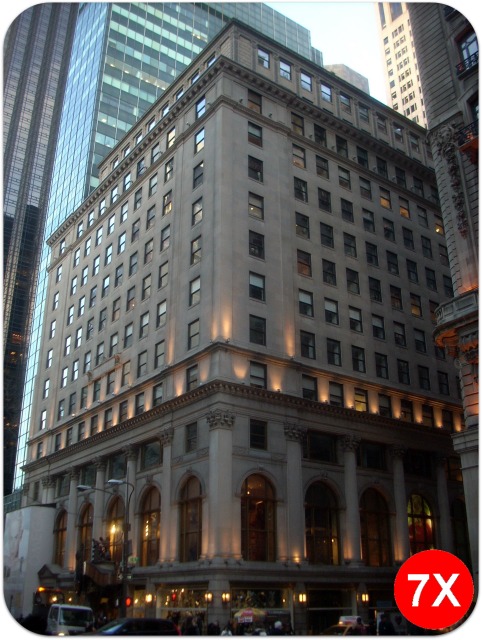
The biggest news in Midtown was that Coca-Cola is planning to move back into its own 61,000-square-foot retail space at the corner of Fifth Avenue and 55th Street in New York City, according to an article in the the real estate section of Crain's New York Business yesterday.

The Disney Store has been leasing the retail space at the ground floor plus basement and two additional levels at 711 Fifth Avenue for about 15 years.  It is moving to another location with about 25,000 square feet at 1540 Broadway in Times Square after this summer.

Long-time Coca-Cola shareholders or collectors probably remember the 711 5th Avenue building was the Columbia Pictures Building until the motion picture company was acquired by The Coca-Cola Company in 1982.  The building then became Coca-Cola's New York Headquarters and also known as the Coca-Cola Building.

In November 1991, Coca-Cola Fifth Avenue store opened on the ground floor of the building selling Coca-Cola brand merchandise from clothing, toys to various mementos and memorabilia.  The retail store closed in March 2000.

Today, the same space is occupied by Omega, the retail store of the Swiss luxury watch maker.  Disney Store's space is to the south of the Omega store.  Between the two stores is the entrance lobby to the office building where you could visibly see the name "The Coca-Cola Company" above the double glass doors.

Last month, I was the only bidder for a collection of Coca-Cola bottler supplier catalogs on eBay.  I won the lot from the seller in Ohio for $2.99 (the shipping was more because of the weight).  One of the items was a press packet for the grand opening of the Coca-Cola Fifth Avenue.

I remember visiting the Coca-Cola Fifth Avenue Store in the mid-90s and bringing home some souvenirs including 8oz souvenir Coke 5th Ave glass bottles and 3" miniature bottle keychain

So I wonder what Coca-Cola has in mind for the retail space vacated by Disney?

Here are some suggestions:
  • Sampling of different Coca-Cola beverages from around the world (similar to the World of Coke in Atlanta). 
  • Rotating exhibit of company memorabilia from Atlanta (I'm sure Phil and Company wouldn't mind escorting the collection from Atlanta to New York periodically).
  • Georgia/Illy Cafe - a cafe that serves Georgia Coffee and Illy Issimo, various tea beverages such as Sokenbicha or Ten Ren, and perhaps some pastries or light snacks
  • Soda fountain that serves Coke in glass the old fashion way for 5 cents
  • Collector events such as trading tables, memorabilia seminars, charity auctions, meet and greet Coca-Cola celebrities, spokespersons, executives, artists and authors.
  • Press events for product launches or sponsorship events for FIFA, Olympics, new films or books
  • Limited edition Coke bottles - one or two per year, but not too many, and should be different from the Atlanta and Las Vegas stores.
September 2019 Update - The Coca-Cola Company sold its Fifth Avenue Building for $909 million to a group of investors.

Coca-Cola Fifth Avenue
Cover postmarked 1991-11-20


Delicious and Delightful New Year - the story of Coca-Cola's Chinese trademark

Happy Chinese New Year! It’s a tradition in Chinese families for the parents and elders to hand out red envelopes with crispy new bills inside to the younger generation. Similar to calendars, some businesses give out complimentary red envelopes to their customers.

Swire Coca-Cola gives away free packets of Coca-Cola red envelopes with purchase of family-size Coke bottles in Taiwan. Each year there are different designs and these red Coke envelopes make nice keepsakes.

New product packages and posters all over Hong Kong are updated with New Year greetings and sharing of the “First Bottle of the New Year.” Coca-Cola’s latest spokesperson in greater China is the Taiwanese pop group “Fahrenheit.”

The four members: Aaron Yan, Wu Chun, Calvin Chen, and Jiro Wang released their first Mandarin album in September 2006 which catapulted them into stardom in Taiwan and China. The Fahrenheit continued their heat wave through Southeast Asia and eventually reaching Chinese listeners in Europe and America.

In Shenzhen, China, outside Rainbow Shopping Center, a large red and gold Coca-Cola display welcomes shoppers and the New Year.

Coca-Cola was first introduced in China in 1927, the year after Coca-Cola set up its Foreign Department which later became The Coca-Cola Export Corporation. Coca-Cola was first sold in the cities of Tianjin and Shanghai where there were already soda water manufacturers established by British merchants. Both cities also had concessions zones where large population of foreigners lived. Most foreigners especially Europeans would not have trouble asking for Coca-Cola by name. Even the locals who had no knowledge of the alphabet (not to mention the high illiteracy rates in China during that period [1]), they could easily recognize Coca-Cola’s iconic bottle and its flowing script.

Nevertheless, how could you sell a consumer product without a product name in the local language?

The story of the early development of the Chinese name for Coca-Cola was told by Norwood F. Allman in his article “Transliteration of 'Coca-Cola' Trade-Mark to Chinese Characters” which appeared in the June 1957 issue of Coca-Cola Overseas magazine.

A Virginia native and a graduate of University of Virginia, Allman lived in China from 1916 to 1950. He worked as a student interpreter in the U.S. Embassy in China and was named United States Consul in Shanghai in 1921. He retired from the consular corps in 1924 and practiced law in Shanghai. While he was in Shanghai, he also served as Coca-Cola’s legal counsel in China. Allman passed away in 1987.

Allman’s account of the unusual initial Chinese transliteration attempts of Coca-Cola had become one of the most popular Coke lore and humorously cited as an example of marketing blunders.

It is possible that Coca-Cola could be transliterated into four Chinese characters that literally mean tadpole bites wax, but these four characters are fairly complex characters with many strokes. I doubt very much that local merchants would have used these characters to advertise a beverage, not to mention many Chinese at the time were illiterate.

Furthermore, the Chinese dialect used in Shanghai is Shanghainese or Wu, which is quite different from Mandarin. If the local Shanghainese merchant wanted to peddle the beverage with a name as exotic as “tadpole bites wax,” they would have called it “namuan kela.” The Shanghainese word for tadpole is “namuan” and bites wax is “kela.”

The same Chinese characters are pronounced differently in different dialects. Mandarin is a northern Chinese dialect and as the lingua franca for China, it has the largest number of speakers. Shanghainese has the second most number of speakers followed by Cantonese spoken in the southern Chinese province and many of the overseas Chinese communities.

The official transliteration for Coca-Cola in Chinese - 可口可樂 - is pronounced ke kou ke le (pinyin) in Mandarin, ku ka ku lo (approximation) in Shanghainese, and hak hao hak lok or ho hao ho lok (approximation) in Cantonese.

In Allman's article, the transcription of 可口可樂 appeared as K'o K'ou K'o Lê using the Wade-Giles romanization system for Mandarin Chinese that was commonly used through most of the 20th century.  In 1958, pinyin, a new romanization system was developed and approved by the government of People's Republic of China.  In pinyin, 可口可樂 is transcribed as Ke Kou Ke Le.

When Coca-Cola returned to China in 1979 after a 30-year hiatus, Coke packaging and advertising began to use simplified Chinese script written as 可口可乐.  Only the fourth character is different from the traditional script.  Taiwan, Hong Kong and Macau continued to use traditional Chinese script in Coca-Cola advertising as the trademark originally appeared more than 75 years ago.  Singapore and Malaysia are the other two countries that have also used Chinese scripts on the Coca-Cola bottles.

Despite the varying pronunciation of the trademark in Chinese, the meaning of the official transliteration is the same for all dialects and is arguably one of the best if not the best example of trademark transliteration into Chinese from English. Kekou kele in Chinese means delicious and joyful. Personally I’d prefer to translate it as Deliciously-Delightful to have the same alliteration as Coca-Cola.

We all know that Frank Robinson is credited with coming up with the name Coca-Cola in 1886, but who came up with the official Chinese rendering of the Coca-Cola trademark. Was it an internal company effort or did it involve some outside marketing firm?

The New Yorker journalist and author E.J. Kahn wrote in his book The Big Drink (p.42) that “the company engaged an Oriental-language specialist. After experimenting with several dialects, he eventually came up with four Mandarin characters - 樂可口可 - that sound like “Coca-Cola,” literally mean “Can mouth can happy,” and, by somewhat free translation, can be said to stand for “Delicious and refreshing.

Note the Chinese characters in Kahn's book is shown written from right to left which is common for signage, but not as common in written text.  Traditional Chinese text is usually written vertically and the columns are read from right to left.  In the age of Internet, Chinese is written horizontally from left to right, especially mixing with western languages and emoticons.

Anyone who picks up a Chinese dictionary will find kekou 可口, the first two characters used in the Chinese transliteration of Coca-Cola, to mean tasty or agreeable to the taste.  The use of the word kekou could be traced back to Zhuangzi's writing in 4th century BC and poems written in the Song and Ming dynasties.

Kele 可樂 on the other hand is more of a free translation to mean rejoice or joyful.  Because of Coca-Cola's transliteration into Chinese using these two characters, it has become a generic term for any cola beverage and it is also used by other competitor's cola products in Chinese speaking countries.  Consequently the term has also made it into even the elementary Chinese dictionaries.  Furthermore, when Chinese speakers ask for Coke, they would just say kele (cola).

Prior to the 2008 Beijing Olympics, Coca-Cola issued a press release "Coca-Cola is Delicious Happiness":
"The message of Delicious Happiness was derived from the transliteration of the Coca-Cola trademark in English lettering to Chinese characters.  When Coca-Cola was first introduced in China in 1927, these Chinese characters were chosen by Company officials to phonetically articulate Coca-Cola and were literally interpreted as "Delicious Happiness" by China's citizens.

Instead of the traditional Chinese script and the Wade Giles romanization of the characters as they appeared in Allman's 1957 article, the "Delicious Happiness" press release shows the transliteration in simplified Chinese script and pinyin.

There is another story of who came up with kekoukele.  Chiang Yee (surname Chiang and first name Yee) has been cited in several articles that appeared in Chinese language newspapers World Journal and People’s Daily as the person responsible for coming up with the Chinese transliteration for Coca-Cola.

The story as told in various versions pretty much boiled down to a contest in the 1930s to name Coca-Cola in Chinese. A scholar who was in London at the time took the challenge and came up with the name ke kou ke le and was rewarded with a cash prize.

I had mentioned this story in a comment to Phil Mooney’s Coca-Cola Conversations Blog, but he could not find any information in the Coca-Cola Archives.

Chiang Yee by Da Zheng
Chiang Yee was born in 1903 in Jiujiang, China and in 1925 graduated from National Southeastern University (renamed Nanjing University in 1949). He was a teacher before serving as the magistrate for counties in Anhui province and finally in his native Jiujiang.

In 1933 he left China for England and taught Chinese at the School of Oriental and African Studies, University of London until 1935. In 1937, he published his first book Silent Traveller: a Chinese Artist in Lakeland. Chiang continued his series of Silent Traveller as he wrote and painted about his travels through London, Yorkshire Dales, Oxford, Edinburgh, New York, Dublin, Paris, Boston, San Francisco and Japan.

Chiang moved to New York in 1955 and became a lecturer in Chinese at Columbia University. He was an Emerson Fellow in Poetry at Harvard University from 1958-1959.

Professor Chiang passed away in 1977.

In January, I came across an article about a Chinese school fundraiser in New England with materials donated by Professor Chiang’s family. I contacted the school and eventually got in touch with the Silent Traveller’s granddaughter earlier this week.

Hsin-Yee Chiang wrote in her e-mail to me on February 9 that her father (Professor Chiang’s second son) confirmed that her “grandfather entered and won an international competition for the naming of the famous soft drink in 1933 while he was in London, for which he was awarded 20 pounds.”

In my 16 years of collecting Coca-Cola advertising memorabilia, this had to be one of my most exciting correspondences.

I mentioned to Professors Chiang’s granddaughter about Phil Mooney’s Blog which she promptly visited and posted her comment confirming her grandfather’s involvement with the Chinese name for Coca-Cola.

I have been researching and looking for the earliest example of ke kou ke le used in advertising. So far the earliest photo I could find was from 1937. In fact, until my recent correspondence, I thought it was from 1932. I found the photo with the caption referring to the Battle of Shanghai without the year. There were two recorded Battles of Shanghai: January 1932 and August 1937.

So my search continues for the earliest Chinese Coca-Cola trademark in advertising and for the details of the naming contest. Until then, I wish you all a very Delicious and Delightful or Coca-Cola Chinese New Year!

[1] Sources of Chinese Economic Growth, 1978-1996 by Chris Bramall.

This article was mentioned by Phil Mooney in his Coca-Cola Conversations blog on February 18, 2010.   Website links in this article were updated in January 2019.

San Francisco Rooftop Coca-Cola Sign (1937-2020)

Ninety years ago in Utah, Tom Young borrowed $300 from his father to start a company that specialized in lighted signs and painted wall signs.  A few years later, Young's company sold neon signs throughout Utah, Idaho, Wyoming and Nevada and was renamed Young Electric Sign Company (YESCO) in 1925.

YESCO installed the famous 75-feet tall Vegas Vic in Sin City in 1951 and the Welcome to Fabulous Las Vegas sign in 1955.  Many more signs on the Strip as well as other landmark signs were also designed and installed by YESCO in the decades to follow.

In 1990, YESCO installed the World of Coca-Cola landmark sign in Atlanta and in 1998 the World of Coca-Cola sign in Las Vegas.  For 2010, YESCO completed a million-dollar project in San Francisco for The Coca-Cola Company.  $1,100,000.00 to be exact according to the building permit filed with the city.

On top of a three-story building at the corner of Bryant and Fifth Streets in SOMA, a 70-feet-by-30-feet LED sign was installed during the wintry December weather of San Francisco.  The new energy efficient sign replaced an earlier neon sign of similar dimensions that advertised "Coca-Cola" in the familiar Spencerian script facing the San Fracisco Bay and "diet Coke" facing the Pacific Ocean.

Both sides of the new outdoor sign now says "Enjoy Coca-Cola."

According to Helen Tarleton, Senior Communications Manager of Public Affairs & Communications at The Coca-Cola Company, "The diet Coke logo on the  previous sign was out-of-date. Since the logos for [Coca-Cola's] other brands (outside of Coke) have changed and may continue to change in future, it was decided to use Coke on both sides since it is essentially timeless and would keep the sign current."

In last November's announcement of the double facelift of the landmark sign, Coca-Cola said that the first billboard appeared atop the building at 701 Bryant in 1937, the year after the San Francisco-Oakland Bay Bridge opened.  The outdoor sign greeted motorist coming into the city from the Bay Bridge.

Courtesy of San Francisco Public Library
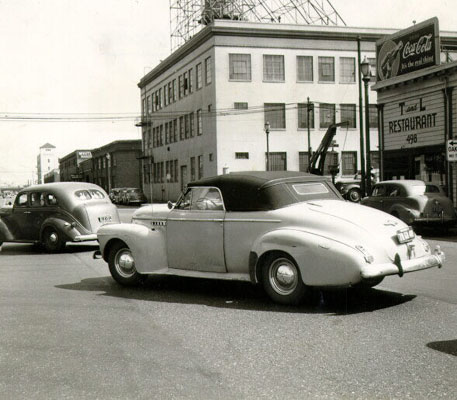
The original billboard probably read "Drink Coca-Cola" instead of "Enjoy Coca-Cola."  I found an old photo of the building from 1947 but unfortunately it did not show the billboard.  There was however a smaller sign on top of T & L Restaurant across the street at 498 Fifth Street.  The sign had a hand holding a Coke bottle with the caption "Drink Coca-Cola - It's the Real Thing."  Click here to see the image in the San Francisco Historical Photograph Collection.

The Coke sign at 498 Fifth Street is no longer there today, but there is a Sprite sign advertising Sarah's Cafe hung from the corner of the building.

The buildling at 701 Bryant Street according to city records was built in 1926.  Its ground floor is occupied by Antonio's Antiques.  The second and third floors are vacant and available for lease.  Wouldn't it be cool to have a World of Coca-Cola attraction in this building.  Just follow the double-sided Coca-Cola LED sign!

October 26, 2020 Update - according to the article on SFGate, Coca-Cola has decided not to renew the lease for the billboard sign and it's being removed at a cost of $100,000.  Farewell!

The Big Drink - Book Review

Ely Jacques Kahn Jr. wrote his first article for The New Yorker in 1937 during his senior year at Harvard.  He served as a field correspondent for the magazine during World War II from the Southwest Pacific while serving in the U.S. Army from 1941-1945 and from Korea during the Korean Conflict. A prolific free-lance journalist, E.J. Kahn, Jr. authored 27 non-fiction books before his death in 1994 at age 77.

In the preface of his seventh book, The Big Drink, Kahn wrote:
"This book is neither a definitive nor an authorized history of the Coca-Cola Company and its monumental works.  The book evolved from a series of articles written for The New Yorker, and the idea of doing them originated with that magazine's editor, William Shawn."
The Universal Drink articles were published in 1959; however, Kahn's first article that mentioned The Coca-Cola Company appeared nine years earlier on July 1, 1950 in the article More Bounce to the Ounce which incidentally profiled the head of Coca-Cola's rival company, Walter S. Mack, Jr., who was appointed Chairman of the Board at PepsiCo that year.

Kahn also disclosed in the preface that he paid $99.50 to purchase one share of The Coca-Cola Company stock so he could receive annual reports and proxy statements from the company in writing the book.  He happily reported that by the time he wrote the preface, his share was worth $149.50.

His one share would have turned into 288 shares in 1994 after seven splits.  His original share purchased for $99.50 would have been worth $11,701.44 based on the closing price of the stock on May 27, the previous trading day before his death.  This does not include the quarterly cash dividends that he had earned during the lifetime of his shares.

Kahn joked about the price of a bottle of Coke going up from a nickel to a dime at The New Yorker office three months after the magazine ran his four-part The Universal Drink series from February - March 1959.

Due to the ever increasing production costs after World War II, many of the Coca-Cola bottlers were unable to maintain the wholesale prices for Coke such that the retailers could sell the 6 1/2 ounce bottles for 5 cents.  The price increase happened as early as 1946 in Los Angeles.  By 1950, retail prices went from 5 cents a bottle to anywhere from 6 cents to 10 cents in some locations.  In March 1959, Atlanta was the last market to increase its wholesale price of a case of Coke from 80 cents to one dollar.  Retail prices for a bottle of Coke also went from a nickel to a dime before the year ended.

Fast forward to December 2009, at Wal-Mart (which began as Sam Walton's five and dime store) you could buy a 2-liter PET bottle of Coke Classic on sale for $1.

2 liters = approx. 67.63 ounces = approx 10 (6 1/2 ounce) bottles

In other words, you could still buy the equivalent of 10 (6 1/2 ounce) bottles of Coke for about a dollar in 2009.

Wow, 50 years after Kahn's The Universal Drink, we could still enjoy The Big Drink for the same price of 10 cents per serving!

Kahn began The Big Drink with Forty Thousand Times Each Minute to establish how big the ocean of Coke was in the 1950s.  The Coca-Cola Company reminded consumers that the big drink was enjoyed 60 million times a day around the globe.

In 2009, the company that gives us the one big drink is now serving nearly 500 brands of drinks at the rate of 1,600 million times a day around the globe.  That's roughly 2,667% increase over the daily consumption rate reported 50 years ago.  This produces a compounded annual growth rate of 6.79% over the past half a century.

Kahn explained how the big drink became more than just Something for the Boys during World War II.  Coca-Cola tactically advanced around the globe with the Allied forces however the drink was met with varying resistance during the post-war era in It Takes a Lot of Patience.  Globalization of the drink driven by profit and its universal appeal continued in You Got to Get It Out to the Jungles.  But more importantly, the people who work for The Coca-Cola Company, also known as Coca-Cola Men, carried the Big Drink to new markets Marching with a Song in Their Hearts.

In Feet and Wings, Kahn chronicled the birth of Coca-Cola in 1886 and the three wise men: John Pemberton, Asa Candler and Robert Woodruff who made Coca-Cola the Big Drink through the end of the 1950s.  Kahn explained how the big drink became big business as Candler agreed in 1899 to allow Benjamin Thomas and Joseph Whitehead to bottle the drink in The Most Important Businessman in TownThe End Result was of course big money for most of those who became part of the big drink franchise.  Big money unfortunately also brought Bugs, Butts and Buncombe and the bottlers to court.  Even Uncle Sam went after the Big Drink in the 1909 case known as the United States v. Forty Barrels and Twenty Kegs of Coca-Cola as told in The Bane of Chromatography: 7X.

The Coca-Cola Company also had to fight off thousands of imitators in Magic Syllables.  Even overseas there were Copa-Kola (Brazil), Coca-Kola (Bolivia), Coco-Kola (Paraguay), Cofa-Cola (Germany), Ola-Cola (Cuba), Loka-Koka (Spain), just to name a few.  One may even argue the value of Coca-Cola's trademark had surpassed the value of its secret formula during the mid-20th century. Meanwhile, the struggle between Coca-Cola and Pepsi-Cola continued in and out of the courts in The Enemy.

In its Relentless Pursuit and Preventive Maintenance, The Coca-Cola Company recognized the importance of strategic management for an ever growing corporation and bottler network around the globe with the recruitment of key individuals.  Equally important was the political liaison of securing near-term relationships in the highest places while taking a longer term perspective in the different political systems.


Kahn went on to explain that advertising played a big role in the success of the Big Drink in Practicing What Archie Preached. Archie Lee of the D'Arcy Advertising Company had "nurtured the subtle, intangible, imponderable image of Coca-Cola" over the growth years.  Coca-Cola's annual advertising budget rose from forty-six dollars in its first year to nearly twenty million in 1959.  The Big Drink's global annual advertising exceeded three billion dollars in 2009.

As recognizable as the Spencerian logo, the patented Coca-Cola bottle has been instrumental in the Big Drink's spectacular growth as Kahn explained in Getting the Drink Drunk.  In 1959, there were 1.5 billion 6.5 ounce returnable glass bottles in circulation with 500 million new bottles being produced per year by independent glass manufacturers.  Each bottle was refilled an average of 35 times over its lifetime and over 6 billion contour-shaped bottles were produced in its first 40 years.

Coca-Cola Men also recognized the important association of youth and sports and the Big Drink in An Innocent Friendship.  In this final chapter, Kahn discussed Coca-Cola's ties to America's favorite pastime. Ty Cobb, a member of the National Baseball Hall of Fame who also shared the same birth year as the Big Drink, was "a Coca-Cola booster before he was a Coca-Cola bottler."  Through its sponsorship of the Olympic Games, Coca-Cola was able to quench the thirst and capture the heart of the young generation of athletes and spectators overseas where local bottlers did not exist.

The 174 pages of The Big Drink is teeming with funny tales of Coca-Cola, the development of the drink, the cokestory and planetary expansion of the company, from its inception to the year 1959.  Kahn's memorable and sometimes romantic accounts of ordinary people and Coca-Cola have perhaps inspired some of the later Coca-Cola advertising.
"A waitress in Tokyo ... once said that Coca-Cola has the sweet-and-bitter flavor of first love" (p.22)
In 1999, Leo Burnett USA produced "First Experience" a 30-second television commercial for The Coca-Cola Company.  Directed by John Madden who also directed the film Shakespeare in Love, the commercial was filmed in a small village outside Ouarzazat in Morocco.

The spot shows three young boys in a desert village wondering what Coca-Cola tastes like.

"I wonder what it tastes like?" asked one boy.

"My Dad says it's like kissing a girl," answered another boy.

The boys laughed.

"They're here," the boys exclaimed and ran towards the village store where a shiny red cooler full of ice-chilled and bottled Coke was unloaded from a beat-up delivery truck.  One of the boys took out a bottle from the cooler to try.

"Is it like kissing a girl?" asked the boy curiously while two young girls giggled nearby.

"I hope so," replied the boy with a big smile after his first gulp and a brief pause.  He then took another gulp of Coca-Cola from the contour-shaped glass bottle.

While the book is a great read on the story of Coca-Cola, The Big Drink does not provide any notes or references for those who are interested in doing further reading or research.  This is not to say Kahn's history of The Coca-Cola Company published by Random House is any less relevant.  In fact, it has provided the foundation for generations of books, articles and reports on the beverage company and industry for the next half a century.  In particular, a fellow Harvard graduate and author, Mark Pendergrast, acknowledged in his first edition of For God, Country and Coca-Cola:
"My work builds on previous books on Coca-Cola by E.J. Kahn, Jr. ... I am personally indebted to E.J. Kahn, Jr., for his humanity and encouragement.  At the outset, he allowed me to forage through his files at The New Yorker and copy over four hundred pages of meticulously indexed notes, which not only gave me concrete information, but served as an exemplary role model."
Interestingly, Pendergrast's first account of The Coca-Cola Company published in 1993 was titled For God, Country and Coca-Cola: The Unauthorized History of the Great American Soft Drink and the Company That Makes It.  In 1999, his revised edition was re-titled For God, Country, and Coca-Cola: The Definitive History of the Great American Soft Drink and the Company That Makes It. Pendergrast has cleverly referenced Kahn's introduction that The Big Drink is neither a definitive nor an authorized history of the Coca-Cola Company.

Kahn saw first hand how Coca-Cola expanded its footprint around the globe for over two decades during his travels.  He himself grew up fluent in French, German and English.  His paternal grandfather was from Austria and his mother's family was French.  Kahn noted how "Drink Coca-Cola" is translated into different languages:
"Spaniards are accustomed to "Beba Coca-Cola," Frenchman to "Buvez Coca-Cola," Italians to "Bevete Coca-Cola," Germans and Swiss to "Trink Coca-Cola," Finns to "Juo Coca-Cola," Swedes to "Drick Coca-Cola," Norwegians to "Drikk Coca-Cola.  It is "Bebam Coca-Cola" in Macao, "Tome Coca-Cola" in much of South America, and "Duem Coca-Cola" in Thailand, as well as ดื่ม โคคา-โคล่า.  In Greece, it is πίνετε Κόκα-Κόλα, in Japan, 飲みましょう コカコーラ, ... "(p.44)
The slogan "Drink Coca-Cola" appears in 18 different languages inside both the front and back covers of The Big Drink as they were used in the 1950s.  The red cover has the iconic hobbleskirt bottle with the crown cap. The dust jacket designed by Paul Bacon has the title and the author's name arranged in the shape of a hobbleskirt bottle.  Even from a distance anyone who sees the cover would recognize that it is a book about Coca-Cola. A photo of the author appears on the back of the dust jacket.

It has been fifty years since The Big Drink was first published and it is as classic and refreshing as the drink itself.  Just as Mark Pendergrast has dedicated his revised book to E.J. Kahn, Jr., I'd like to dedicate this article to the memory of the Coca-Cola chronicler.


The Big Drink book review also appeared in the April 2010 issue of The Coca-Cola Collectors News.  Website links in the article were updated in January 2019.

Coca-Cola's Greatest Hits - 100 Years of Coca-Cola and Music Celebrities

Born in 1872 in Leavenworth, Kansas , singer Hilda Clark became the first celebrity model for The Coca-Cola Company.  Also known as the First Coca-Cola Girl, Hilda's image was used on cardboard signs, tin trays, trade cards, bookmarks, drink tickets, and calendars from 1899 to 1903.

From 1904 to 1905, Lillian Nordica became the new face of Coca-Cola .  Born Lillian Norton in 1857 in Farmington, Maine, Madame Nordica was also a singer who had performed with the Metropolitan Opera in New York, as well as in many major musical venues in Western Europe and Russia.

These early calendars and other promotional items featuring the divas of the time not only launched the popular Coca-Cola Girls advertising platform but Clark and Nordica items had also become some of the greatest hits with vintage Coca-Cola collectors over the years.  Hilda Clark signs from 1901 and Lillian Nordica cardboard signs from 1905 have been valued recently in the five figures. 

Born in 1910 in Calcutta, India, Jessica Dragonette, became the first Coca-Cola Girl to sing on the first radio program sponsored by the Coca-Cola Company in 1927.   Known anonymously as Vivian the Coke Girl, soprano Dragonette sang in the half-hour serial program syndicated on 14 NBC radio stations.   That same year, The Coca-Cola Company also published a song entitled "The Coca-Cola Girl."  The lyric and music were written by Howard E. Way.  

Another song with Coca-Cola in the title but not by The Coca-Cola Company was heard on the radios in America towards the end of World War II.  This popular calypso composed originally by Lord Invader and Lionel Belasco, performed by the Andrew Sisters, climbed to the top of the Billboard in February and March of 1945.   "Rum and Coca-Cola" became the first chart buster celebrating the highball which was first served in 1900 in Havana, Cuba. Also known as Cuba Libre, Rum and Coke gained further popularity after the 1945 hit.  Incidentally, a few months later, the name Coke was registered as a trademark with the US Patent and Trademark Office, and The Coca-Cola Company officially recognized and announced that "Coke means Coca-Cola."

The Coca-Cola Company continued to sponsor radio programs including the Edgar Bergen & Charlie McCarthy radio program on CBS in October 1949.   Born in 1903 in Chicago, Illinois, Edgar Bergen, best known as a ventriloquist, was an Academy Award winner and Radio Hall of Fame honoree.  The Charlie McCarthy Show was selected as an honored program in 1990.

The first Coca-Cola television commercial debuted in November 1950 featuring the dynamic duo Bergen and McCarthy.  The following month Coca-Cola sponsored Walt Disney's television premiere on Christmas Day - "One Hour in Wonderland."   Coca-Cola continued television program sponsorships such as the popular Western series "The Adventures of Kit Carson" from 1951-1955 , Disney's "Mickey Mouse Club" on ABC from 1955 to 1957   and the variety show "Coke Time with Eddie Fisher" on NBC from 1953-1957.

By mixing pop music and Coca-Cola on the airwaves in the late 1950s, Coca-Cola's Hi-Fi Club on the Top-40 radio stations in 325 cities across the US attracted 2 million teenage card-carrying members.  Hi-Fi Club members listened to their favorite music on the radio and enjoyed both the biggest hits and Coke at weekly dance parties hosted by the local Coca-Cola bottlers.

The Coca-Cola Company added new jingles which became classic hits on the radio and television in the 1960s.  The McGuire Sisters sang "Really Refreshed"   Miss Oklahoma 1958 Anita Bryant, a popular singer in the 1960s  became the latest Coca-Cola Girl on radio and television from 1964-1967.  Marvin Gaye, Ray Charles, Otis Redding, Roy Orbison, Petula Clark, the Supremes, the Moody Blues, Jay and the Americans, and other popular singers all contributed their renditions of "Things Go Better with Coke."

Aretha Franklin, Queen of Soul, sang at President Barack Obama's inauguration on January 21, 2009.  She sang for Coca-Cola on radio in 1967 and appeared in her first Coke magazine ad in 1968.

"Things Go Better with Coke" campaign was followed by "It's the Real Thing" in 1969.   This new campaign gave birth to the Coca-Cola's greatest hit of all time - "I'd Like to Buy The World a Coke"  Also known as the Hilltop commercial released in July 1971, the imagery and song resonated with the viewing American public.  Coca-Cola and its bottlers received more than a hundred thousand letters by November that year. It was also one of the most listener requested commercials at the radio stations across the nation. Following the success of the Hilltop commercial, "I'd Like to Teach the World to Sing" recorded by the New Seekers attained number 1 on the charts in the UK in December 1971 and climbed to #7 in the US.

Another popular hit which climbed to #2 on the country charts in 1973 was "Country Sunshine."  Country singer Dottie West wrote "Country Sunshine" for The Coca-Cola Company in 1973, based on her 1968 hit "Country Girl" which was used in another Coke commercial.  The single released after the commercial also made it to #49 on the Billboard Hot 100 in 1973.   Glen Campbell, Aretha Franklin, Jerry Reed also recorded jingles for the "Look Up, America" campaign in the 1970s.

Memorable hits from Coca-Cola continued through the 1980s and 1990s with "Have a Coke and a Smile," "Coke is it," "Can't Beat the Feeling," and "Always Coca-Cola."  Singers sang for Coca-Cola included: Blondie, Randy Travis, and Selena. The Diet Coke World Premiere gala commercial was filmed with Hollywood celebrities at the Radio City Music Hall in New York City.  "Just for the Taste of It," Paula Abdul, Elton John, Whitney Houston and the Pointer Sisters all recorded commercials for Diet Coke.

The greatest hit from 1990s would have to be the computer animated "Northern Lights" video for launching the "Always Coca-Cola" campaign in 1993.  Creator Ken Stewart enlisted animation studio Rhythm & Hues and Glenn Rueger of Outside Music to collaborate on these 30-second Polar Bear spots which became instant classics. Ken Stewart got the inspiration for the arctic mascots from his Labrador Retriever which had resembled a polar bear as a puppy.

A Star Search alumna and Mickey Mouse Club Class of 1994 , Christina Aguilera appeared in the Pop the Top Coca-Cola television commercial in 2001.  Pop and R&B singer and song writer Christina dyed her hair red and white for the Coke video.  A century after Hilda Clark, the latest Coca-Cola Girl appeared in life-size posters in thousands of retail outlets across the country, and in full-page ads in large circulation magazines such as People, Rolling Stones, and Entertainment Weekly.  In addition to print, radio, television, in-theater and Internet ads, 50 million packages of Coca-Cola Classic were distributed to promote the chance to meet Christina and go behind the scenes on her music video set.  

In June 2002, Coca-Cola launched the 21st century version of the Fifties Hi-Fi Club on the Internet.  Cokemusic.com was an interactive website featuring streaming radio, music demo creation, music downloads and personalized v-ego avatar characters.   By May 2003, Coke's virtual Hi-Fi Club attracted teens with a passion for music, word of the site had spread by e-mail and Internet chat instead of the radio waves. Cokemusic.com attracted over a million page views a day, an average growth of over 200,000 unique visitors per month, and average visits lasting longer than 25 minutes.

Partnered with AOL Music, Cokemusic.com featured eight recording artists each month.  Members could read musician biographies, listen to their music and watch their videos simply from their home computer.  When Coke launched its "Coca-Cola... Real" campaign in January 2003, it first debuted the campaign's signature tune on CokeMusic.com. Members could download "Real Compared to What," by R&B/Hip-Hop artists Mya and Common.  An extended version of the tune was released on Mya's album shortly after the campaign.

With Coke's fountain of taste innovation flowing, we saw the expansion of Coca-Cola flavors with the launch of Vanilla Coke in 2002.  The new Vanilla Coke was launched in New York City at a party hosted by singer Deborah Gibson and joined by MTV personality Brian McFayden and celebrity Nikki Hilton.

In addition to new flavors, Coca-Cola introduced new caloric offerings with the launch of Coke C2 in 2004.  The new mid-calorie cola launch used the Rolling Stones song "You Can't Always Get What You Want" and Queen's "I Want to Break Free."    A year later, Coca-Cola launched Coke Zero with "Chilltop," a remake of the 1971 Hilltop classic.  Instead of the hilltop in Italy, the video was filmed on a rooftop in Philadelphia.    The music was performed by popular artist and Philly native Garrett Dutton III, better known as G. Love.  Getting "Everyone Chill" with Coke Zero in the new Chilltop, G. Love was born in 1972 after the Hilltop hit.

Thirteen years after the first computer animation hit "Northern Lights," Coca-Cola created another hit "Happiness Factory" in 2006 as part of the "Coke Side of Life" campaign.  The ad became the highest rated spot globally and received a Silver Lion at the 2007 Cannes advertising awards.  Coca-Cola followed up with another animated hit aired during Super Bowl Sunday 2007 with "Coca-Cola: Grand Theft Auto."  In this spot, Coca-Cola turned a wildly successful yet violent video game Grand Theft Auto into a heart-warming instant classic for both fans and critics. 

In the age of YouTube, all these popular Coca-Cola videos with animated polar bears and unforgettable music sung on an Italian hilltop could not match the Internet sensation "Diet Coke and Mentos" video which did not originate from The Coca-Cola Company.  Known as the "the Extreme Diet Coke & Mentos Experiments," Fritz Grobe and Stephen Voltz created a backyard experiment with exploding fountains from 200 liters of Diet Coke and 500 Mentos mints.  The video shown on EepyBird.com went on to become one of the most watched videos on the Internet.  It won a Webby Award for best viral video in 2007 and was nominated for an Emmy Award for outstanding broadband content.

One of the earlier promotions on Cokemusic.com was a tie-in with a television talent show to win prizes such as the red couches from the show's Coca-Cola red room after its first season.  The new star search show, American Idol, debuted on Fox television network in 2002.  Paula Abdul, who sang for Diet Coke a decade earlier, became a judge on this reality show sponsored by the Coca-Cola Company.

Just as Paula continued to be one of celebrity judges on the show in its eighth season, American Idol continued to reign as the most popular reality television show in America. Coca-Cola also continued to be one of the show's major sponsors.  Coca-Cola's latest "Open Happiness" global campaign aired its television commercial during American Idol on January 21, 2009.

For 110 years from Hilda Clark to American Idol, The Coca-Cola Company has blended popular music and refreshment in harmony through its association of Coke with celebrity performers and the creation of some of the most memorable and greatest hits in beverage history.  After all, wouldn't you like to teach the world to sing in perfect harmony?

The Coca-Cola's Greatest Hits was the winner of the The Coca-Cola Collectors Club Membership Newsletter Contest in 2009 and appeared in the July-August 2009 issue of The Coca-Cola Collectors News.